

Kafka
Run a single-node Kafka-protocol broker, with its topics declared in doze.hcl and a web console, without a JVM.
On this page
Runs Kafka 1 – 4 · macOS and Linux · registry page ↗
Run a Kafka broker for your producers and consumers, with the topics declared in doze.hcl and a console to watch them.
Kafka itself runs on the JVM, and the usual local answer is Docker and a gigabyte of images. This module is a single-node broker written in Go, from the doze Kafka project. It speaks the Kafka wire protocol, with consumer groups (classic and KIP-848), compaction and retention, so any Kafka client connects to it. It is for building and testing, not a production cluster.
version is the Kafka protocol profile your clients expect (1 to 4), not a
broker build.
Topics
Section titled “Topics”module kafka "events" { version = 4 auto_create_topics = false
topic "orders" { partitions = 3 } topic "payments" { config = { "cleanup.policy" = "compact" } }}Declared topics are created on the broker’s first start. Larder, the made-up
shop in these docs, sets auto_create_topics = false: its topics are the
contracts between services, so they are declared rather than created by
whichever client writes first. Leave it on, and default_partitions and
retention apply to topics clients create.
Connect a client
Section titled “Connect a client”A broker’s reference is .address, the host and port a client bootstraps
from:
app "emailer" { run = "go run ./cmd/emailer" env = { KAFKA_BROKERS = module.events.address }}cl, _ := kgo.NewClient( kgo.SeedBrokers(os.Getenv("KAFKA_BROKERS")), kgo.ConsumerGroup("emailer"), kgo.ConsumeTopics("orders"),)From a terminal, with kcat:
doze url events# events.shop.doze:9092kcat -b "$(doze url events)" -t orders -P <<< '{"order":1}'kcat -b "$(doze url events)" -t orders -C -o beginningThe broker wakes on the first connection. A consumer keeps its connection
open, so a stack with a running consumer keeps Kafka awake, which is what you
want. An app that only consumes Kafka gets no requests of its own, so give it
sleep = "never", as Larder does for orders (Sleep and wake).
The console
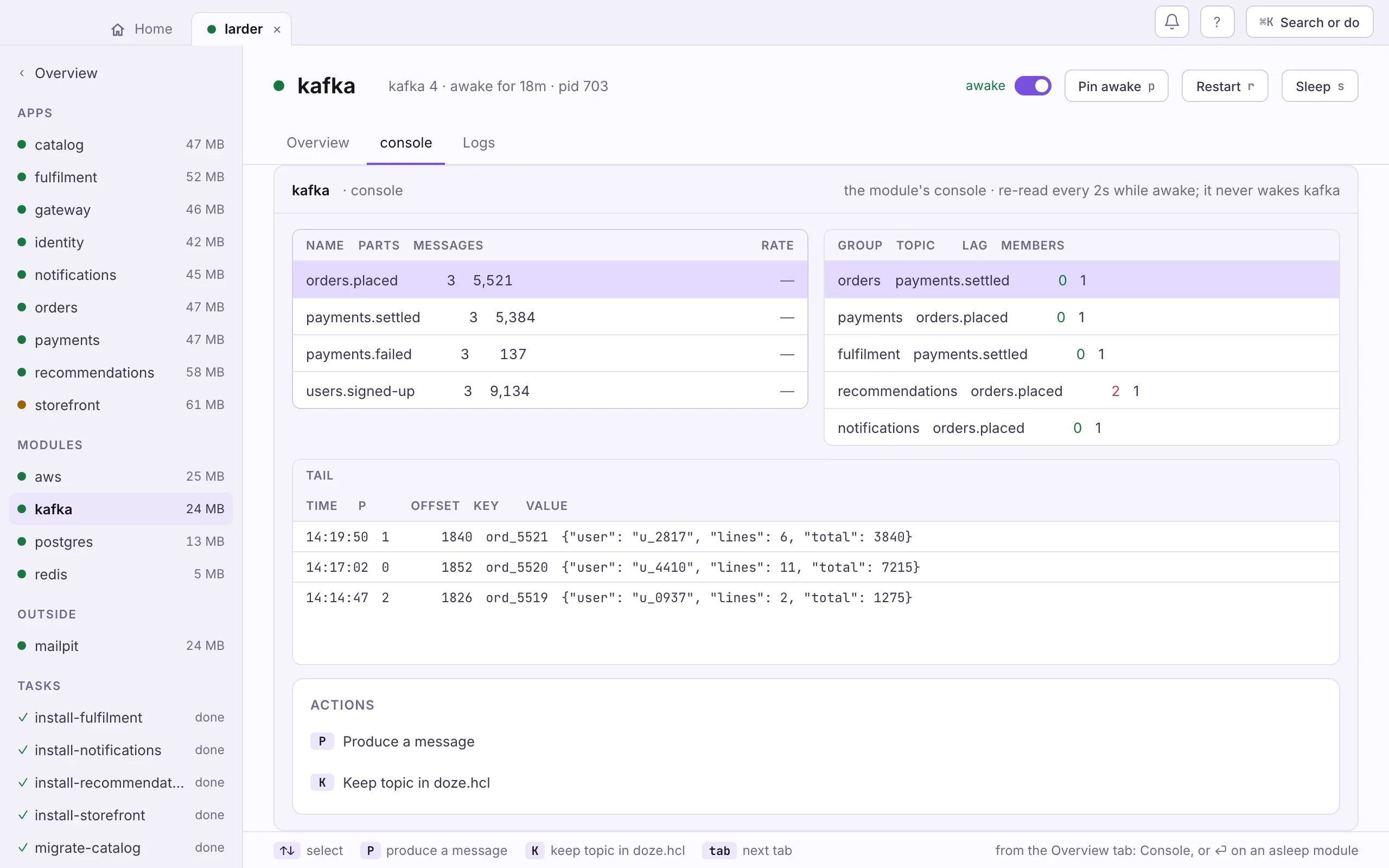
Section titled “The console”The broker serves a web console one port above its own (9093 for a broker
on 9092): topics with a live tape of messages, a produce panel, offsets per
partition, and consumer groups with their lag. In the app it is the service’s
Console tab.
Reference
Section titled “Reference”A local, disk-backed broker that speaks enough of the Kafka wire protocol that unmodified clients (franz-go, kcat, Sarama, the Java client) connect and work. No JVM, no ZooKeeper, no KRaft — the engine is doze-kafka, embedded in the module, and version selects the Kafka protocol profile it advertises (1–4). Declare topics and doze converges them on boot; auto-create handles the rest.
Every field at once
Section titled “Every field at once”module kafka "events" { version = 4 port = 9092
auto_create_topics = true default_partitions = 1 retention = "168h"
topic "orders" { partitions = 3 } topic "payments" { partitions = 1 config = { "cleanup.policy" = "compact" } }}Versions you can declare
Section titled “Versions you can declare”The version = you write is the engine’s own version. doze fetches and
verifies it, pins it in doze.lock, and picks the module release that
provides it.
1 · 2 · 3 · 4
Fields
Section titled “Fields”| Field | Type | Default | Description |
|---|---|---|---|
version |
number | — | Advertised Kafka protocol profile — 1, 2, 3, or 4. Required. |
auto_create_topics |
bool | true |
Create unknown topics on first reference. |
default_partitions |
number | 1 |
Partition count for auto-created topics. |
retention |
string | — | Delete segments older than this (Go duration, e.g. “168h”); empty = unbounded. |
retention_bytes |
number | — | Delete old segments once a partition exceeds this size (0 = unbounded). |
Every module block also takes doze’s own fields: port, listen, sleep,
after, enabled, routes, count and for_each
(doze.hcl reference).
Nested blocks
Section titled “Nested blocks”topic "<name>" { … } — A topic to create on boot.
| Field | Type | Default | Description |
|---|---|---|---|
partitions |
number | 1 |
Partition count. |
config |
map(string) | — | Per-topic config (e.g. cleanup.policy = compact). |
Module releases
Section titled “Module releases”The releases of the module that provide this engine. doze picks the newest
one that fits your doze and your version =, and pins it in doze.lock;
you never write these. Older releases stay available for pinned lockfiles.
| Release | Engine versions | Platforms | |
|---|---|---|---|
0.1.2 |
1 · 2 · 3 · 4 | 3 | stable |
0.1.1 |
1 · 2 · 3 · 4 | 3 | |
0.1.0 |
1 · 2 · 3 · 4 | 3 |
Signed data: index.yaml ↗ · meta.yaml ↗