

AWS
Run local AWS (S3, SQS, SNS, DynamoDB, Lambda and more) as one service, with buckets, queues and tables declared in doze.hcl.
Runs AWS · macOS and Linux · registry page ↗
Run the AWS services your app calls on your machine, with the buckets, queues, topics and tables declared in doze.hcl, behind one endpoint every AWS SDK understands.
One aws block is one process from the
doze AWS project, written in Go: S3,
SQS, SNS, DynamoDB (with Streams), Lambda, EventBridge, KMS, SSM Parameter
Store, Secrets Manager, STS and Step Functions behind one gateway, with a web
console at /_console. No Docker, no JVM. It is for building and testing,
not a stand-in for AWS in production.
There is no version: the services follow the current AWS APIs.
The block
Section titled “The block”Larder, the made-up shop in these docs, keeps product images and receipts in S3 and hands pick lists to the warehouse over SQS:
module aws "aws" {  port = 4566
  bucket "product-images" {}  bucket "receipts" { versioning = true }
  queue "pick-lists" {    dlq          = "auto"    max_receives = 5  }}
Everything inside is created when the service first starts, updated when you
change it, and kept on disk across sleeps. dlq = "auto" makes a
pick-lists-dlq queue and sends a message there after five failed receives.
Point your SDK at it
Section titled “Point your SDK at it”app "catalog" { run = "go run ./services/catalog" port = 8002 env = { AWS_ENDPOINT_URL = module.aws.url IMAGES_BUCKET = "product-images" }}Every current AWS SDK reads AWS_ENDPOINT_URL. Resources are plain names.
The SDK still wants credentials and a region; the local services accept any.
From a terminal, doze env prints all of it:
eval "$(doze env aws)"aws s3 lsaws sqs get-queue-url --queue-name pick-listsdoze env exports AWS_ENDPOINT_URL, AWS_ACCESS_KEY_ID,
AWS_SECRET_ACCESS_KEY and AWS_REGION.
Its address
Section titled “Its address”With names on, the service is reached at its name: a block called aws in a
stack called shop is http://aws.shop.doze (with port declared, that port
is added). Every name under it reaches it too, so SDKs that put the service or
the bucket in the host work unchanged: sqs.us-east-1.aws.shop.doze, and S3 by
virtual host (uploads.s3.us-east-1.aws.shop.doze) without
force_path_style. routes = false keeps it on its port only. See
Names and addresses.
Queues, topics and fan-out
Section titled “Queues, topics and fan-out”module aws "aws" { queue "emails" { dlq = "auto" max_receives = 5 }
queue "orders.fifo" { fifo = true }
topic "signups" { subscribe { queue = "emails" raw = true } }}A subscribe block in a topic delivers each message to a queue (or a Lambda
or an HTTP endpoint).
DynamoDB
Section titled “DynamoDB”module aws "aws" { table "sessions" { key = "session_id:S" ttl = "expires_at" }}key is "name:type", with a sort key after a space: "pk:S sk:N". Streams
are on, so a Lambda can follow a table’s changes.
Lambda and EventBridge
Section titled “Lambda and EventBridge”module aws "aws" { function "resize" { code = "./functions/resize" timeout = 10 }
rule "order-placed" { pattern = "{\"source\":[\"shop.checkout\"]}" targets = ["lambda:resize", "queue:emails"] }}code is a folder with a bootstrap executable (the provided.al2
runtime); the function runs as a local process. PutEvents on the default
bus delivers to every rule whose pattern matches.
Keys, parameters and secrets
Section titled “Keys, parameters and secrets”module aws "aws" { key "app" {} parameter "/app/feature/banner" { value = "on" } secret "db-password" { value = "local-only" }}The console
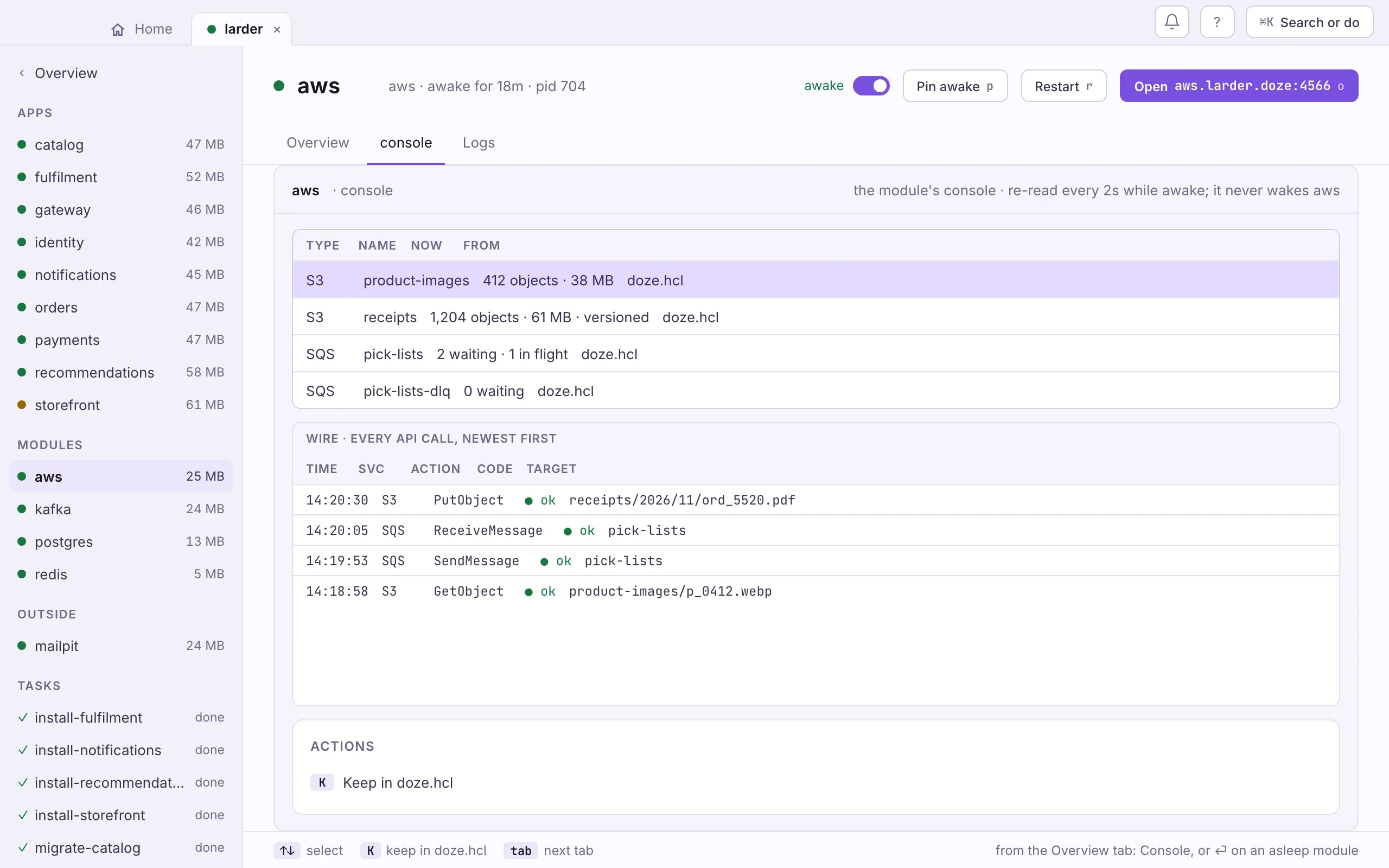
Section titled “The console”/_console on the service’s address has a page per service: browse buckets
and objects, peek at and purge queues, scan tables, invoke functions. Its
Traffic tab shows every API call your app makes. In the app it is the
service’s Console tab.
Reference
Section titled “Reference”Every doze-aws service — S3, SQS, SNS, DynamoDB, Lambda, EventBridge, Step Functions, Kinesis, API Gateway, CloudFormation, IAM, KMS, SSM, Secrets Manager, STS — behind one gateway on one endpoint, as one doze instance. Declare buckets, queues, topics, tables, functions, rules, keys, secrets, parameters and state machines as nested blocks (the same resource graph doze-aws compiles a CloudFormation template down to); doze converges them on boot. A stock SDK or the aws CLI points AWS_ENDPOINT_URL at the one endpoint; the web console at /_console manages everything, with the live Flows graph and a Traffic tail capturing every call. One process, no Docker, no JVM, no LocalStack.
Every field at once
Section titled “Every field at once”module aws "local" { port = 4566
bucket "uploads" { versioning = true } queue "emails" { dlq = "auto" max_receives = 5 } queue "orders" { fifo = true content_dedup = true }
topic "signups" {
subscribe {
queue = "emails"
raw = true
} }
table "sessions" { key = "session_id:S" ttl = "expires_at" }
function "resize" { code = "./functions/resize" # dir with a provided.al2 bootstrap timeout = 10 }
rule "order_placed" { pattern = "{\"source\":[\"shop.checkout\"]}" targets = ["lambda:resize", "queue:emails"] }
key "app_key" {} secret "db_password" { value = "s3cr3t" } parameter "/app/feature/banner" { value = "hello" }
state_machine "order_flow" { definition = <<-ASL { "StartAt": "Resize", "States": { "Resize": { "Type": "Task", "Resource": "arn:aws:lambda:us-east-1:000000000000:function:resize", "Retry": [{"ErrorEquals": ["States.TaskFailed"], "MaxAttempts": 2}], "Next": "Notify" }, "Notify": { "Type": "Task", "Resource": "arn:aws:states:::sqs:sendMessage", "Parameters": {"QueueUrl": "http://localhost:4566/000000000000/emails", "MessageBody.$": "$"}, "End": true } } } ASL }}Versions
Section titled “Versions”This engine takes no version =: it tracks current APIs.
Fields
Section titled “Fields”This engine has no top-level fields of its own.
Every module block also takes doze’s own fields: port, listen, sleep,
after, enabled, routes, count and for_each
(doze.hcl reference).
Nested blocks
Section titled “Nested blocks”bucket "<name>" { … } — One S3 bucket (the label is the bucket name).
| Field | Type | Default | Description |
|---|---|---|---|
versioning |
bool | false |
Enable object versioning. |
object_lock |
bool | false |
Enable object lock (implies versioning). |
queue "<name>" { … } — One SQS queue; dlq = “auto” creates and wires a dead-letter companion.
| Field | Type | Default | Description |
|---|---|---|---|
fifo |
bool | false |
FIFO queue (name gets .fifo). |
dlq |
string | — | “auto” or an existing queue name. |
max_receives |
number | — | Receives before dead-lettering. |
topic "<name>" { … } — One SNS topic with subscribe blocks (queue/lambda/http, filter, raw).
No fields: the label is the declaration.
table "<name>" { … } — One DynamoDB table; key uses the “pk:S sk:N” shorthand, plus gsi/lsi blocks.
No fields: the label is the declaration.
function "<name>" { … } — One Lambda function running as a real local process (code = local dir).
No fields: the label is the declaration.
rule "<name>" { … } — One EventBridge rule; targets use “queue:name”/“topic:name”/“lambda:name”.
No fields: the label is the declaration.
key "<name>" { … } — One KMS key with real local crypto.
No fields: the label is the declaration.
secret "<name>" { … } — One Secrets Manager secret (never stomped without force).
No fields: the label is the declaration.
parameter "<name>" { … } — One SSM parameter (the label is the full /path).
No fields: the label is the declaration.
state_machine "<name>" { … } — One Step Functions state machine, run locally against the stack’s functions, queues and topics.
| Field | Type | Default | Description |
|---|---|---|---|
definition |
string | — | The States Language document — a heredoc, or file(“./flow.asl.json”). Required. |
role |
string | — | Role ARN; the API requires one and nothing local evaluates it, so it defaults. |
type |
string | STANDARD |
STANDARD or EXPRESS (Express executions arrive after Standard ones). |
Module releases
Section titled “Module releases”The releases of the module that provide this engine. doze picks the newest
one that fits your doze and your version =, and pins it in doze.lock;
you never write these. Older releases stay available for pinned lockfiles.
| Release | Engine versions | Platforms | |
|---|---|---|---|
0.2.0 |
3 | stable | |
0.1.1 |
3 | ||
0.1.0 |
3 |
Signed data: index.yaml ↗ · meta.yaml ↗